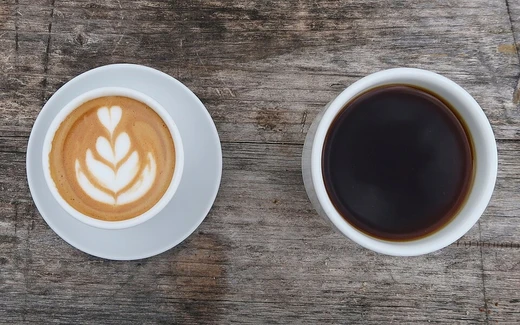
Latte
Italian coffee drink of espresso and steamed milk.
Latte, also known as caffè latte, caffellatte, caffelatte, or caffè e latte, is a coffee drink of Italian origin made with espresso coffee and steamed milk, traditionally served in a glass. It is distinguished from a cappuccino by its larger serving size and lack of a thick foam layer, resulting in a milkier and milder coffee taste.
- first_attested_in_english
- 1867 (in William Dean Howells' 'Italian Journeys')
Lore & Background
The drink is said to have technically originated in 17th-century Europe. In William Dean Howells' 'Italian Journeys', published in 1867, he notes being served a drink described as 'cafè latte' on a steamship traveling from Trieste to Venice. The modern caffè latte appeared in the 20th century, following the invention of the espresso machine in the 19th century, made possible by the addition of the steam wand to the espresso machine, which was developed in later innovations such as Desiderio Pavoni's 1905 patent, allowing heating and texturing milk.
Reader's Guide
The caffè latte is a foundational coffee drink that has spread globally from its Italian roots. Its significance lies in its role as a milder, milkier alternative to cappuccino, and as the basis for latte art, a technique using microfoam to create patterns on the drink's surface. In Italy, it is typically consumed at breakfast, while in the United States it is often heavily sweetened with sugar, artificial sweeteners, or agave syrup. The term 'latte' in English derives from the Italian caffè e latte, meaning 'coffee and milk', and its first English attestation dates to 1847. The drink's evolution from 17th-century European origins to a modern espresso-based beverage reflects broader changes in coffee culture and technology.
Did You Know?
- In Italian, 'latte' means 'milk'; ordering a 'latte' in Italy results in a glass of milk.
- The term 'caffè latte' is first attested in English in 1867, in William Dean Howells' 'Italian Journeys', before the development of the espresso machine.
- The modern caffè latte became possible after the addition of the steam wand to the espresso machine, a development credited to later innovations such as Desiderio Pavoni's 1905 patent.
- A caffè latte is served in a larger 230 mL (8 US fl oz) glass or cup, while a cappuccino is served in a small 150–180 mL (5–6 US fl oz) cup.
Frequently Asked Questions
What exactly is a latte?
A latte is an Italian coffee drink built on espresso and a generous pour of steamed milk, topped with just a thin layer of microfoam. The result is a smooth, milk-forward sip that feels much milder than a straight espresso shot.
How is a latte different from a cappuccino?
Both start with espresso, but a latte is served in a noticeably larger volume and carries only a delicate cap of foam rather than the thick, airy foam layer a cappuccino is known for. That extra milk and less foam give the latte its signature gentle, milky coffee flavor.
Where did the latte come from?
The drink is rooted in Italian coffee culture, and the phrase 'caffè latte' showed up in English-language writing as early as 1847. It has long been a everyday staple in Italian cafés rather than a trendy modern invention.
What is latte art and why is it associated with lattes?
Latte art is the pour technique in which a barista swirls microfoamed milk into the espresso to draw patterns like hearts or rosettas on the surface. Because a latte's thin foam layer is ideal for this kind of surface work, the two have become closely linked in coffee culture.
How is a latte traditionally served?
In its classic Italian form, a latte is poured into a tall glass so the layers of espresso and milk are visible. It is typically larger than a cappuccino and enjoyed as a soft, milk-rich coffee rather than a strong, bold one.
More in Coffee 1-15
Spotted an error? Know more?
This is a living reference — every entry is fact-audited, and reader corrections feed straight into our audit queue. Suggest an edit · See this site's audit record